
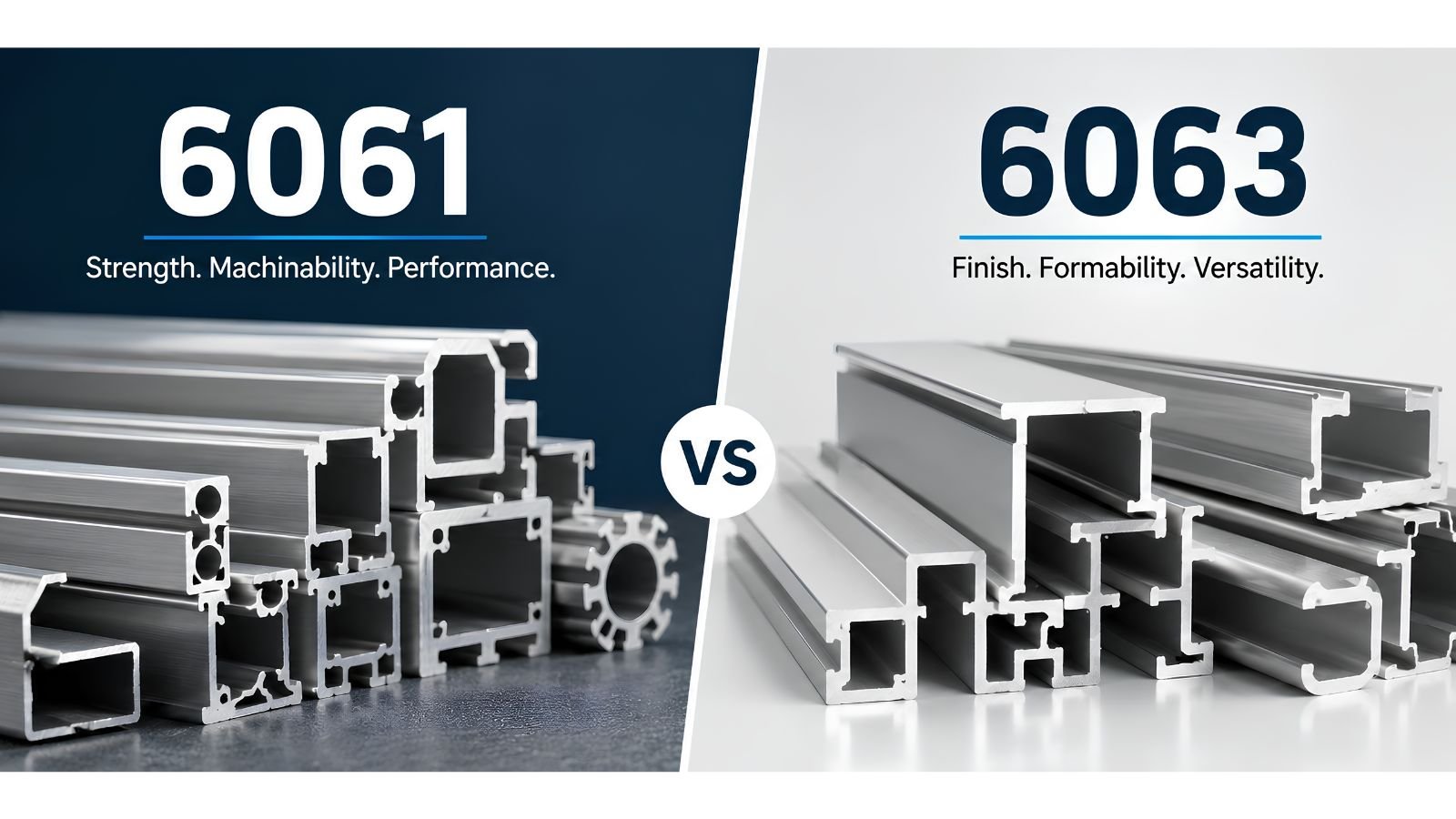
"6061 is strong, 6063 is architectural" is the answer most people give when asked about these two alloys — and it's directionally correct. But it skips the actual reason: a relatively small shift in chemistry is what drives every practical difference between them, from press load and surface finish to anodizing quality and which applications each one ends up in.
This guide goes through the comparison properly — chemistry first, then strength, extrudability, surface finish, heat treatment, machining, corrosion, welding, and finally a straightforward selection guide.
1. It Starts With Chemistry
Both alloys belong to the 6xxx (Al-Mg-Si) family and are heat-treatable — meaning magnesium and silicon combine during ageing to form strengthening Mg₂Si precipitates. But 6061 is allowed noticeably higher magnesium and silicon, and deliberately includes copper and chromium at levels 6063 doesn't carry.
| Element | 6061 (wt.%) | 6063 (wt.%) |
|---|---|---|
| Silicon | 0.40 – 0.80 | 0.20 – 0.60 |
| Magnesium | 0.80 – 1.20 | 0.45 – 0.90 |
| Copper | 0.15 – 0.40 | ≤ 0.10 |
| Chromium | 0.04 – 0.35 | ≤ 0.10 |
| Iron | ≤ 0.70 | ≤ 0.35 |
| Manganese | ≤ 0.15 | ≤ 0.10 |
| Zinc | ≤ 0.25 | ≤ 0.10 |
| Titanium | ≤ 0.15 | ≤ 0.10 |
Figures shown are typical composition ranges consistent with EN 573-3 and common published alloy data sheets. Always confirm against the specific standard and mill certificate governing your order.
6061 is the more heavily alloyed of the two — higher Mg, a wider Si range, and specified Cu and Cr content. 6063 runs a leaner recipe. That single fact is the root cause of almost everything else in this comparison.
2. Why Is 6061 Stronger?
Both alloys strengthen through the same basic mechanism: magnesium and silicon combine during ageing to form fine Mg₂Si precipitates that physically obstruct dislocation movement through the metal's crystal structure — the more effectively this happens, the higher the resulting strength.
6061's richer Mg-Si chemistry, plus its copper and chromium content, supports a meaningfully stronger alloy system than 6063's leaner composition allows.
| Typical property (T6) | 6061-T6 | 6063-T6 |
|---|---|---|
| Ultimate tensile strength | ~310 MPa | ~205–240 MPa |
| Yield strength | ~276 MPa | ~170–214 MPa |
| Elongation | ~10–12% | ~8–15% |
These are typical published values, not guaranteed minima for every size, temper or specification — mechanical requirements vary with product form, wall thickness, temper, and the governing standard (EN 755-2, ASTM B221, etc.).
Say: "6061-T6 typically develops substantially higher strength than 6063-T6; exact specified properties depend on product form, dimensions and the applicable standard."
3. Why Is 6063 Easier to Extrude?
This is where the comparison connects directly to your press floor. 6063's leaner chemistry gives it noticeably lower flow stress at extrusion temperature — in plain terms, it takes less pressure to push it through a die, and it tolerates more intricate, thinner-walled geometry while doing so.
6061 → higher deformation resistance, generally demands more care with press load, speed, thermal control and die design.
This difference is exactly why 6063 dominates:
- Window and door profiles
- Curtain-wall sections
- Complex, multi-cavity architectural profiles
- Thin-wall extrusions
- Decorative sections
6061 is still extruded widely — but it's generally chosen where the mechanical requirement justifies taking on a more demanding alloy to extrude.
4. Why Does 6063 Give a Better Surface Finish?
6063 tends to develop a finer grain structure than 6061, and its tighter limits on elements like iron and copper mean fewer intermetallic particles that can disrupt an anodized surface. In visible architectural work, that matters a lot — anodizing reveals microstructural non-uniformity rather than hiding it.
This is exactly why 6063 became so strongly linked with the combination of architectural extrusion + anodizing + visible surface quality.
5. Extrusion Behaviour, Side by Side
| Factor | 6061 | 6063 |
|---|---|---|
| Extrudability | Moderate to good | Excellent |
| Complex sections | More challenging | Very suitable |
| Thin walls | More process-sensitive | Well suited |
| Typical extrusion speed | Lower | Higher |
| Press load tendency | Higher | Lower |
| Surface finish | Good | Excellent |
| Decorative anodizing | Good, process-dependent | Excellent |
| Strength potential | Higher | Medium |
Note what's deliberately missing from this table: a fixed number for extrusion speed or press load. Those depend on billet chemistry and homogenisation, extrusion ratio, die design, press capability, billet temperature, and the exit-temperature limit for that specific alloy and profile — not on the alloy name alone. Treat any claim like "6063 extrudes 30% faster than 6061" as a rule of thumb, not a fixed number you can rely on without your own trial.
6. Heat Treatment: Where Comparisons Go Wrong
You cannot meaningfully compare "6061 vs 6063" without also specifying which temper of each. 6061-T4, 6061-T6, 6061-T6511, 6063-T5 and 6063-T6 are all genuinely different metallurgical conditions with different properties.
In broad terms: T5 means cooling from an elevated-temperature shaping process (like extrusion) followed by artificial ageing — no separate solution heat treatment step. T6 means a full solution heat treatment followed by artificial ageing, which generally produces higher strength than T5 for the same alloy.
This matters enormously on the plant floor: the extrusion exit temperature and the quench that follows it have to be controlled precisely enough to create the supersaturated condition that later ageing depends on. If quenching is inadequate:
Poor supersaturation → reduced ageing response → lower final strength than the temper designation implies.
This process-control requirement becomes especially critical when a higher-strength temper has been specified by the customer or the governing standard.
7. Machining: 6061 Usually Has the Edge
6061 is widely regarded as having good machining characteristics, and specialised improved-machinability variants of 6061 exist specifically for high-speed CNC work. This makes it a natural fit for:
- Machine components and fixtures
- Structural frames
- Marine hardware
- Automotive components
- Machined extrusion parts (brackets, connectors, fittings)
6063 can absolutely be machined too — but if a component needs significant machining combined with higher mechanical strength, 6061 is usually the more logical starting point.
8. Corrosion Resistance
Both alloys offer good general corrosion resistance — this is a shared strength of the whole 6xxx family. Be cautious of the common internet claim that "6063 has better corrosion resistance than 6061." There can be real differences depending on environment, temper and surface treatment, but the safer, more accurate statement for technical content is:
9. Welding: Weldable Doesn't Mean Unaffected
Both 6061 and 6063 weld well using standard aluminium processes (TIG and MIG are both common), but both are heat-treatable alloys — which means welding locally disrupts the precipitate structure that gave the parent material its strength.
A welded 6061-T6 assembly should never be assumed to retain full T6 strength right next to the weld — the heat-affected zone typically drops toward a T4-like condition immediately after welding, with some natural-ageing recovery over the following days to weeks. Where structural welds are involved, this needs to be accounted for in design, not discovered afterward.
10. Thermal and Electrical Applications
6063 is commonly associated with electrical and thermal applications thanks to its good electrical conductivity, and heat sinks are a textbook 6063 use case. But 6061 is used for heat sinks and heat exchangers too — so "heat sink = 6063 only" is an oversimplification worth avoiding.
The real selection depends on a combination of:
- Thermal performance requirement
- Fin/profile geometry complexity
- Mechanical load the part needs to carry
- Post-extrusion machining requirement
- Surface finish expectations
- Cost and production volume
For a complex, thin-finned heat sink where extrudability and surface quality dominate, 6063 is often the more attractive choice. Where the heat sink also carries structural load or needs significant machining, 6061 comes back into consideration.
The Simple Selection Guide
| Choose 6063 when… | Choose 6061 when… |
|---|---|
|
Architectural appearance matters Complex extrusion geometry is required Thin walls are important Anodized appearance is critical High extrusion productivity is desired Medium strength is sufficient |
Higher structural strength is required The component carries meaningful load Significant machining is involved Structural toughness matters Marine, transportation or engineering use drives the design |
Conclusion
6061 and 6063 are both Al-Mg-Si alloys from the same family — but a relatively small shift in chemistry changes where each one belongs. 6061 trades extrudability for strength and machinability. 6063 trades strength for extrudability and surface quality. Neither is the "better" alloy in general — the right choice depends entirely on what the profile needs to do, and how it needs to look once it's finished.