
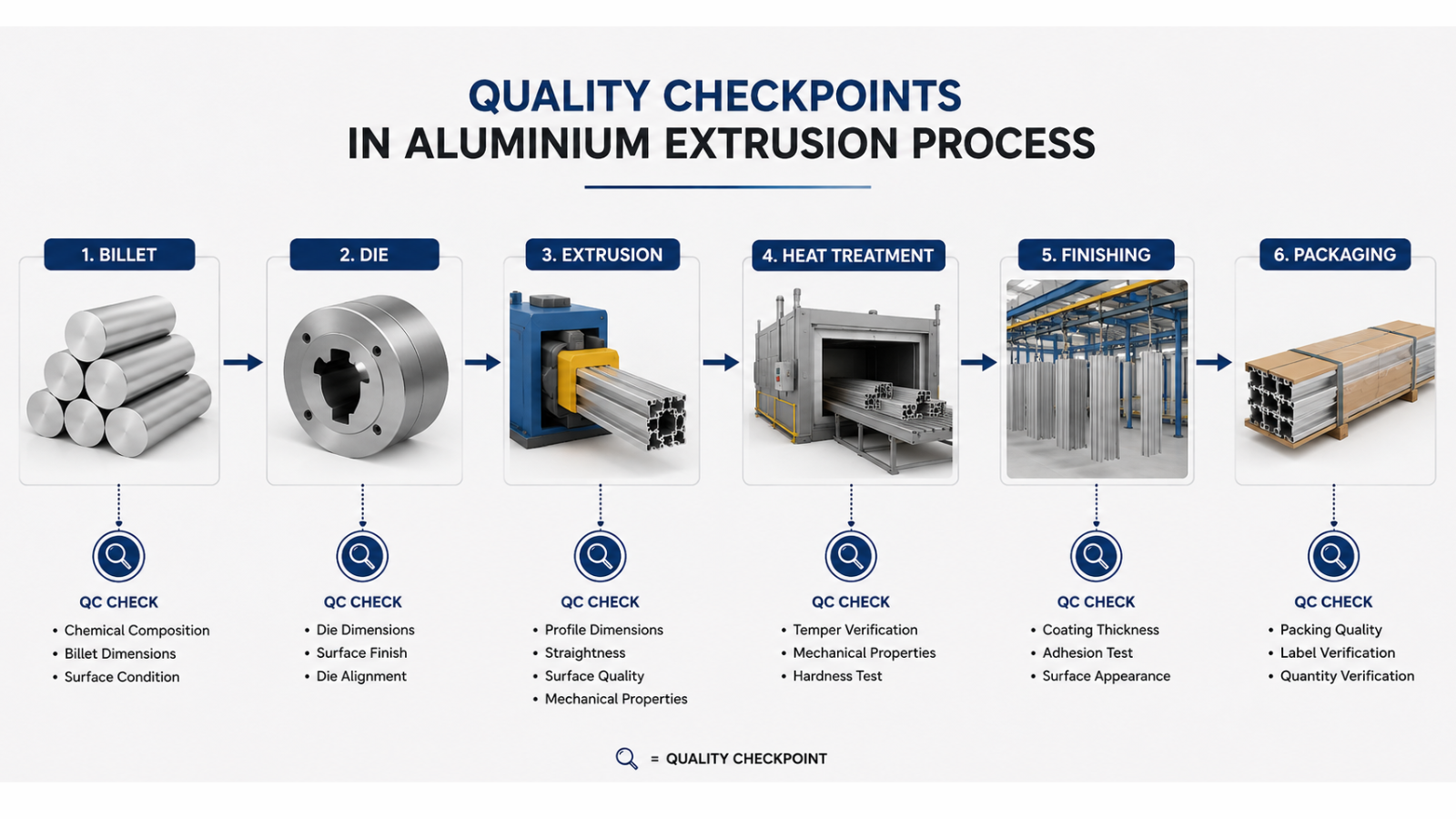
Quality in aluminium extrusion isn't created at the final inspection table — it's built in at every stage before that, starting with supplier selection and billet quality, running through die design, extrusion, heat treatment, and finishing, and ending with packaging and documentation. One of the most common mistakes buyers make is relying only on a supplier's ISO certificate, or inspecting the finished profile only after it arrives. By that point, any defect is already expensive to fix.
This guide lays out a complete, step-by-step supplier qualification and quality assurance framework — the kind procurement teams, OEMs, and fabricators should work through before committing to an extrusion partner, not after the first bad batch.
Why Quality Control Matters
Poor-quality extrusion doesn't just mean cosmetic complaints. It shows up as:
- Assembly issues and dimensional mismatch
- Structural failure in load-bearing applications
- Water leakage in architectural window and door systems
- Poor anodizing or powder coating appearance
- Customer complaints and warranty claims
- Increased scrap and production delays
- A higher total procurement cost than the quoted price ever suggested
Step 1 — Clearly Define Your Product Requirements
Before contacting any extrusion supplier, prepare a detailed technical specification covering:
| Requirement | Example |
|---|---|
| Alloy | 6063, 6061, 6082, 6005A |
| Temper | T5, T6, T66 |
| Drawing revision | Latest approved CAD version |
| Dimensional tolerance | EN 755-9 / EN 12020 |
| Surface finish | Mill finish, anodized, powder coated |
| Mechanical properties | Tensile strength, yield strength |
| Packaging | Individually wrapped, palletised |
| Annual quantity | Monthly and yearly demand forecast |
| Critical dimensions | Functional/mating dimensions flagged on drawing |
Without a clear specification in hand, even a genuinely good extrusion plant can't consistently deliver what you actually need.
Step 2 — Evaluate the Extrusion Plant Before Ordering
Supplier selection is your first real quality checkpoint. Check manufacturing capability directly:
- Number of extrusion presses and their capacities
- Maximum profile size they can produce
- Minimum wall thickness capability
- Maximum circumscribing circle diameter (CCD) they can handle
- Hollow-profile and multi-void experience
- Thin-wall extrusion capability
A mature supplier usually serves several industries — building & construction, solar, electrical, railways, automotive, aerospace, industrial equipment, medical, electronics — but different industries carry very different quality expectations, so match the supplier's actual track record to your specific requirement, not just their industry list.
Step 3 — Verify Quality Certifications
ISO certification alone doesn't guarantee product quality, but it does indicate documented quality management processes exist. Ask for current copies and verify validity of:
Essential: ISO 9001, EN 755 compliance, ASTM B221 compliance.
Industry-specific, where applicable: IATF 16949 (automotive), AS9100 (aerospace), ISO 14001, ISO 45001.
Depending on your application and target market, EN 755, EN 12020 and ASTM B221 define alloy requirements, tolerances, and mechanical property expectations — confirm which one governs your order and stick to it consistently.
Step 4 — Audit Their Raw Material Control
Excellent extrusion starts with excellent billets. Ask directly:
- Who supplies your billets, and is that supply consistent?
- Are billets homogenised before extrusion?
- Is every batch traceable back to a specific heat/cast number?
- Is spectrometer testing performed on incoming billet?
- Are Mill Test Certificates available for every batch?
Poor billet quality is a common root cause of surface streaks, blisters, cracks, and inconsistent mechanical properties — problems that look like extrusion-process defects but actually started upstream.
Step 5 — Review Die Management Practices
Ask: Is die design done in-house? How is die correction managed and documented? Is die maintenance logged? How often are dies nitrided? Are dies polished on a defined schedule, or only reactively? Poor die maintenance shows up downstream as die lines, scratches, twist, dimensional variation, and uneven metal flow — issues covered in depth in our articles on die lines and bearing length and metal flow.
Step 6 — Understand Process Control During Extrusion
Professional plants monitor process parameters continuously, not just at the end of the line. Four parameters matter most:
| Parameter | Too high / fast | Too low / slow |
|---|---|---|
| Billet temperature | Grain growth, surface tearing | Poor metal flow, incomplete filling |
| Die temperature | Surface defects, excessive die wear | Dimension variation |
| Extrusion speed | Pickup, surface cracks | Reduced productivity |
| Quenching | Correct cooling ensures required mechanical properties, proper ageing response, and dimensional stability | |
Step 7 — Evaluate Heat Treatment & Ageing
For 6xxx-series alloys, heat treatment is where a lot of final mechanical performance is decided. Improper ageing produces low hardness, poor tensile strength, and inconsistent properties batch to batch. Ask: T5 or T6 process? How often are ageing ovens calibrated? Is temperature actually recorded during the cycle, or just set and assumed? Has the ageing cycle been validated against the specified temper?
Step 8 — Verify Dimensional Inspection Capability
Check what inspection equipment is actually on the floor: digital calipers, micrometers, height gauges, a profile projector, a Coordinate Measuring Machine (CMM), and optical measurement systems. High-precision manufacturers typically use CMMs and optical measurement alongside traditional gauges specifically to verify customer drawings and tolerance compliance — not just spot-check a few dimensions by hand.
Step 9 — Surface Quality Inspection
Every batch should be checked for scratches, die lines, pickup, blisters, dents, twist, bow, oxide marks, colour variation, and gloss consistency. For anodized product, add coating thickness, colour uniformity, staining, and burn marks to the checklist. For powder coating, check film thickness, adhesion, gloss, orange peel, and pinholes.
Step 10 — Mechanical Testing
Depending on your application, request tensile test results, yield strength, elongation, and hardness data. Test methods should comply with the applicable standard, and results are typically included in the material certification or mill test report — don't accept a shipment with these fields left blank.
Step 11 — Review Laboratory Facilities
A professional extrusion plant should have (in-house, or through an accredited partner lab): a spectrometer, tensile testing machine, hardness tester, metallurgical microscope, coating thickness gauge, and salt spray testing capability.
Step 12 — Review Documentation
Every shipment should arrive with a Mill Test Certificate (MTC), chemical composition report, mechanical test report, inspection report, packing list, and traceability information. Good documentation is what lets you trace any future quality issue back to the original billet and production lot — without it, root-cause investigation becomes guesswork.
Step 13 — Conduct a Supplier Audit
If at all possible, visit the plant in person and inspect:
- Billet storage and die storage conditions
- Press condition and general housekeeping
- Ageing ovens
- Packing area
- Inspection laboratory and calibration records
- Worker training and production planning discipline
Step 14 — Produce Trial Samples First
Before committing to mass production, get a prototype and a first-article sample. Check dimensions, assembly fit, surface finish, functionality, and mechanical properties on that sample specifically. Only approve full production after this validation passes — not before.
Step 15 — Define an Incoming Inspection Plan
Don't skip incoming inspection just because the supplier is certified. A reasonable plan covers:
- Visual inspection — surface defects
- Dimensional inspection — critical dimensions per drawing
- Mechanical testing — random batch verification
- Coating thickness — for anodized/powder coated product
- Material verification — review certificates, and run independent testing when the application justifies it
For high-value or safety-critical applications, it's worth verifying chemical composition and mechanical properties through an accredited third-party laboratory occasionally, even from a trusted supplier.
Step 16 — Monitor Supplier Performance Continuously
Track supplier KPIs on an ongoing basis rather than only at renewal time:
| KPI | Reasonable target |
|---|---|
| On-time delivery | > 95% |
| Rejection rate | < 1% |
| Customer complaints | Minimal, trending down |
| Corrective action response | < 7 days |
| Repeat defects | Zero recurring issues |
| Documentation accuracy | 100% |
| First pass acceptance | > 98% |
Regular reviews against these numbers surface trends early — before a slow drift becomes a major quality event.
Questions Every Buyer Should Ask Before Selecting an Extrusion Plant
- Which alloys do you regularly extrude?
- What is your largest press capacity, and is it currently free capacity or fully booked?
- Can you actually produce this specific profile — have you made something comparable before?
- Which international standards do you manufacture to?
- How do you verify billet quality before it goes into the press?
- Do you provide Mill Test Certificates as standard, or on request only?
- What inspection equipment do you use for dimensional checks?
- How do you maintain and correct extrusion dies?
- Can I audit your manufacturing facility?
- What is your average rejection rate, honestly?
- How do you handle customer complaints when they happen?
- How do you ensure batch traceability?
- What packaging methods do you offer for my transport route?
- Can you support PPAP, APQP, or customer-specific documentation if my industry requires it?
Common Mistakes Buyers Make
- Choosing a supplier on price alone
- Not clearly specifying alloy and temper
- Leaving tolerances undefined or vague
- Skipping prototype/first-article approval
- Never requesting Mill Test Certificates
- Assuming ISO certification alone guarantees quality
- Never auditing the supplier's actual facility
- Skipping incoming inspection entirely
- Poor communication of engineering changes after the first order
Procurement Checklist Before Releasing a Purchase Order
| Checkpoint | Status |
|---|---|
| Technical drawing approved | ☐ |
| Alloy & temper finalised | ☐ |
| Applicable standards defined | ☐ |
| Supplier audit completed | ☐ |
| Certifications verified | ☐ |
| Billet traceability confirmed | ☐ |
| Die approval completed | ☐ |
| Sample approved | ☐ |
| Inspection plan agreed | ☐ |
| Test reports requested | ☐ |
| Packaging requirements confirmed | ☐ |
| Delivery schedule finalised | ☐ |
Final Thoughts
Successful aluminium extrusion sourcing is built on prevention, not inspection. The most reliable buyers work collaboratively with their extrusion partner — defining clear technical requirements, qualifying the supplier thoroughly, validating prototypes before committing to volume, and monitoring quality continuously across the relationship rather than only at the point of complaint.
This systematic approach reduces scrap, cuts costly rework, improves delivery reliability, and — over time — builds a genuinely strong supplier relationship rather than a transactional one. Follow this framework and you'll have a repeatable process for sourcing aluminium extrusions that consistently meet design, performance, and regulatory requirements, order after order.
References & Further Reading
- The Aluminum Association — extrusion standards and technical resources
- ASTM B221/B221M — Standard Specification for Aluminum and Aluminum-Alloy Extruded Bars, Rods, Wire, Profiles and Tubes
- EN 755 series — Aluminium and aluminium alloys, extruded rod/bar, tube and profiles
- EN 12020 series — Extruded precision profiles in alloys EN AW-6060 and EN AW-6063
- Lim, Y.P. & Lim, H.K. — "Quality Assurance of Aluminium Extrusion for 6xxx Series Alloys," in Recent Advancements in Aluminum Alloys, IntechOpen